
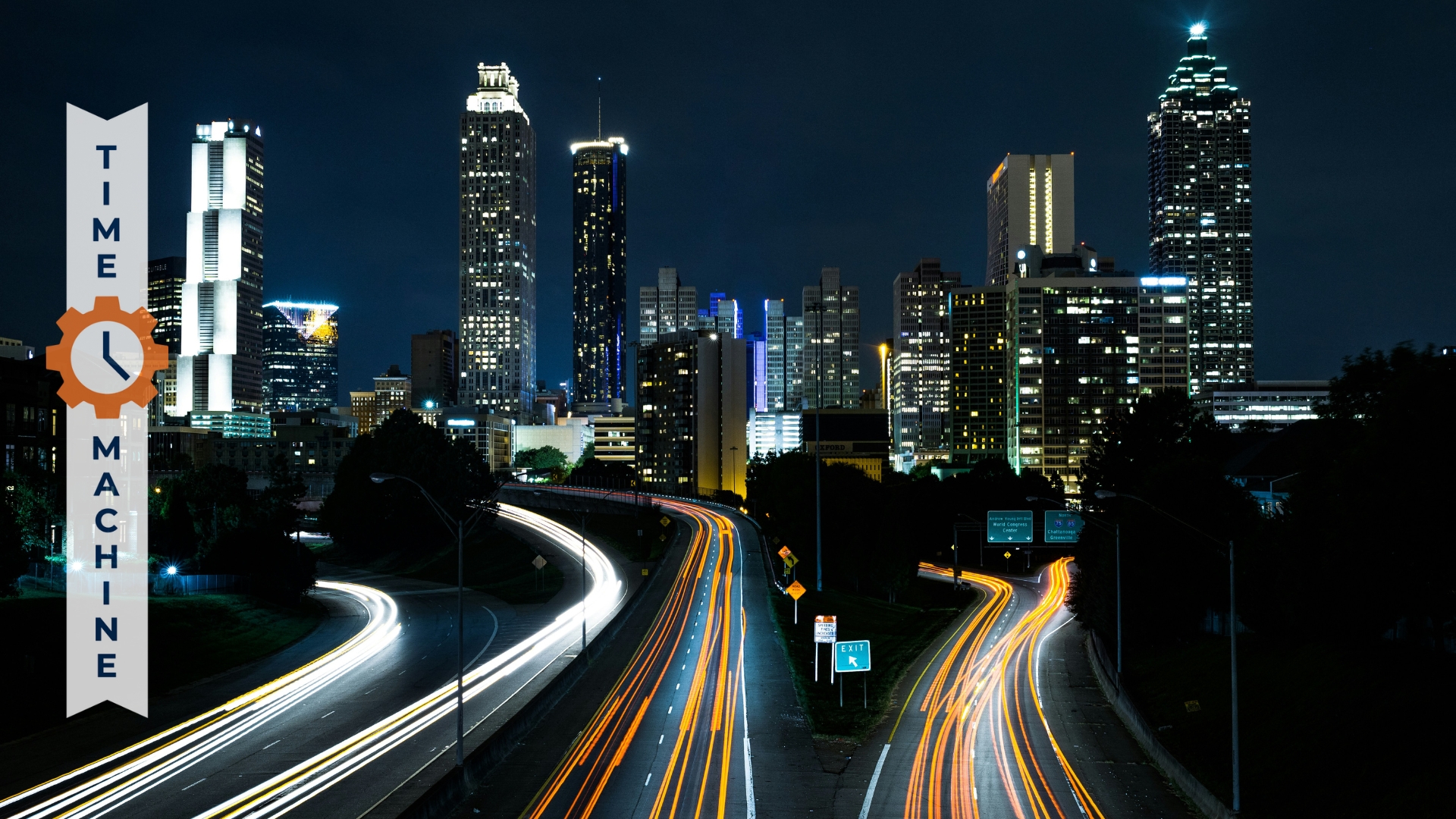
For over a century, the American auto industry has shaped how people live, travel, and connect. But, behind the freedom of the open road is a story of change driven by safety concerns, environmental goals, and public demand. From seat belts to electric vehicles, what Americans expect from their cars has evolved.
This transformation is even seen in pop culture. In Cars 3, Lightning McQueen is challenged by a new generation of racers designed for speed and efficiency, reflecting real-world shifts in how vehicles are built and used. Over time, government policy, public opinion, and technology have worked together to build a safer and cleaner road ahead.
In 1956, President Eisenhower signed the Federal-Aid Highway Act into law, launching a $25 billion (nearly $300 billion today) project to build 41,000 miles of interstate highways. At the time, it was the largest public works project in U.S. history and, over the ensuing decades, radically changed American life. That same year, a Gallup poll found that 76% of Americans supported building more express or superhighways between large cities, showing strong public backing for the large project even before construction began.
But, with new, faster highways came concerns about auto safety.
In 1966, passage of Highway Safety Act and the National Traffic and Motor Vehicle Safety Act authorized the federal government to create and enforce more safety rules. This led to requirements such as having seat belts and head rests in the cars, energy-absorbing steering wheels, and shatter-resistant windshields. A Gallup poll from the same year showed that 54% of Americans who had seat belts in their car used seat belts “some of the time” while 32% used seat belts “always.”
Two decades later, airbags became widely available after years of research and limited production runs. In 1986, Mercedes-Benz became the first automaker to make airbags standard in its U.S. vehicles. In 1984, a Cambridge Reports National Omnibus Survey showed that 37% supported requiring passive restraints, such as airbags, while 42% favored mandatory seat belt laws, highlighting public support for more government vehicle safety rules.
By 1995, 49 states had seat belt laws. Airbags saved 475 lives in 1995 and seat belts cut fatal injuries by 45% to front seat passenger occupants, proving their life-saving impact. A 1999 Roper Starch Worldwide/Insurance Research Council Poll found that among those who had recently bought or leased a car in the past three years, 61% said safety features like airbags and anti-lock brakes were the most important factor influencing their decision.
About 20 years after airbags became the “new” auto safety standard, Electronic Stability Control (ESC) became mandatory in all new passenger vehicles sold in the U.S. This 2012 requirement marked another major step forward auto safety — this time by focusing on preventing crashes in the first place. That same year, the federal government finalized a rule requiring backup cameras in all new cars by 2018 to address rising concerns over backing accidents. By 2017, consumer demand for advanced driver assistance was growing, with 30% of drivers (asked of those who do not already have each item) saying they would want blind spot awareness and 27% selecting automatic emergency braking, according to an AARP/GfK poll.
Another huge change in auto culture came in response to the 1973-74 oil embargo. Congress passed the Energy Policy and Conservation Act of 1975, establishing the first-ever Corporate Average Fuel Economy (CAFE) standards. These rules required automakers to dramatically improve fuel efficiency from 15.2 mpg to 27.5 mpg by 1985. At the time, public opinion strongly supported improvement in fuel efficiency. A 1979 Opinion Research Corporation poll found that 89% of Americans favored providing incentives to automakers to improve fuel efficiency.
In 2007, the Energy Independence and Security Act was signed into law, aiming to reduce U.S. dependence on foreign oil and cut emissions by improving energy efficiency. One of its most impactful provisions raised fuel economy standards to 35 miles per gallon by the year 2020. A 2008 Rockefeller Foundation/Time Magazine poll found that 79% of Americans supported higher fuel economy standards, with 59% “strongly” in favor.
Reducing emissions have gone hand in hand with efficiency standards but, in 2021, President Biden signed Executive Order 14037 setting a national goal for 50% of all new passenger cars and light trucks sold by 2030 to be zero emission vehicles. The order also directed federal agencies to begin developing new emissions and fuel economy standards for vehicles starting with model year 2027. President Donald Trump rescinded the rules in 2025. But, by that time, roughly 7% of all new car sales were electric vehicles (EVs), so the impact may be muted.
From interstate highways to electric vehicles, the auto industry has changed alongside public opinion, government policy, and advancing technology. Safety features, fuel standards, and clean energy goals show how cars have evolved to meet the needs of a changing society. The road forward continues to be shaped by the push for a safer, more efficient future.
This post was written by Marist Poll Media Team member Tommy Rogers